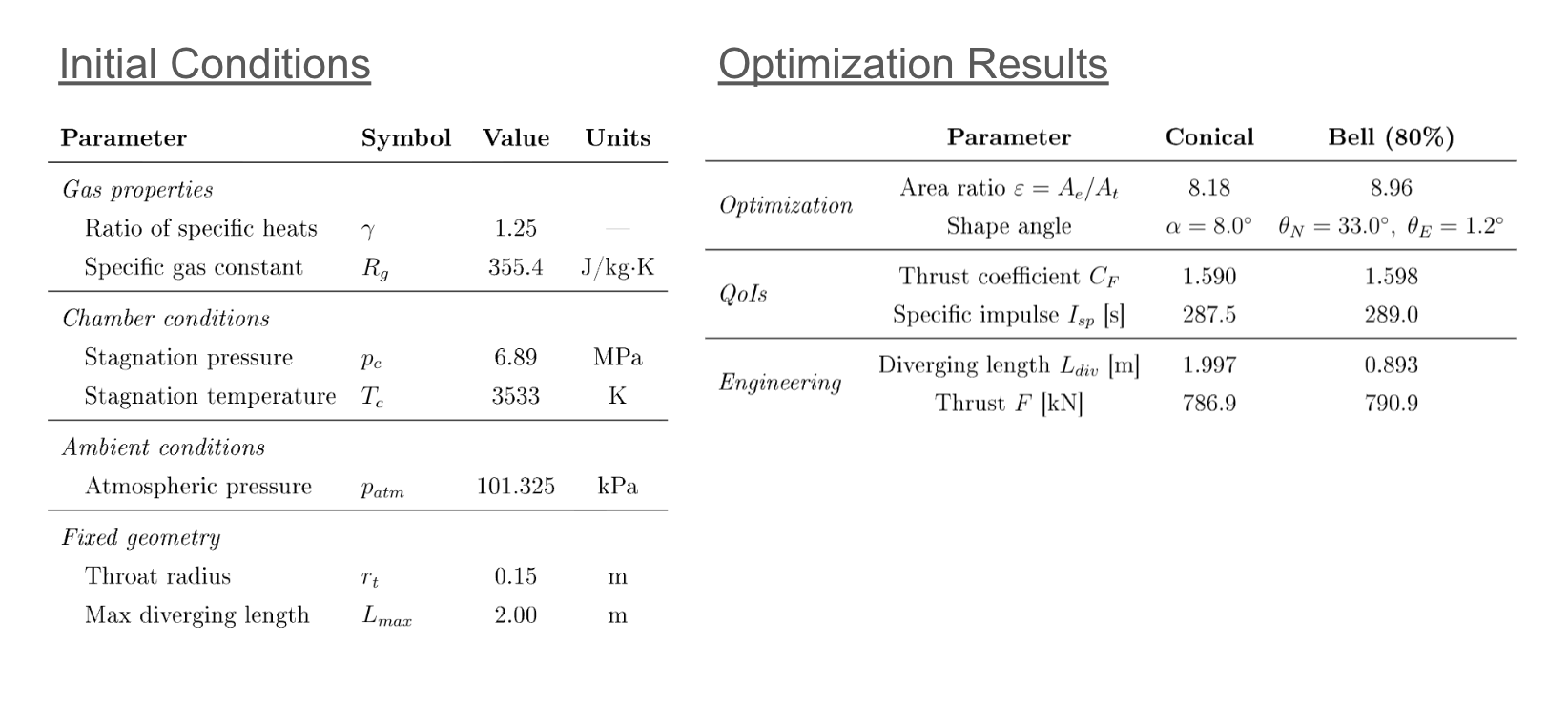
Rocket nozzles are a crucial component of rocket engines, propulsing the engine's exhaust gases to supersonic speeds to create thrust. Optimizing the nozzle ensures exhaust gases reach optimal velocity and pressure to maximize performance. In this project, my team and I use MATLAB to design a sea-level rocket engine nozzle around the follwing constraints: 0.15m throat area, 2m maximum nozzle length, 3500K chamber temp., 7.0 Mpa chamber pressure, 0.101325 MPa ambient pressure (sea-level), and 1.2 specific heat ratio (approximate for RP-1/LOX combustion).
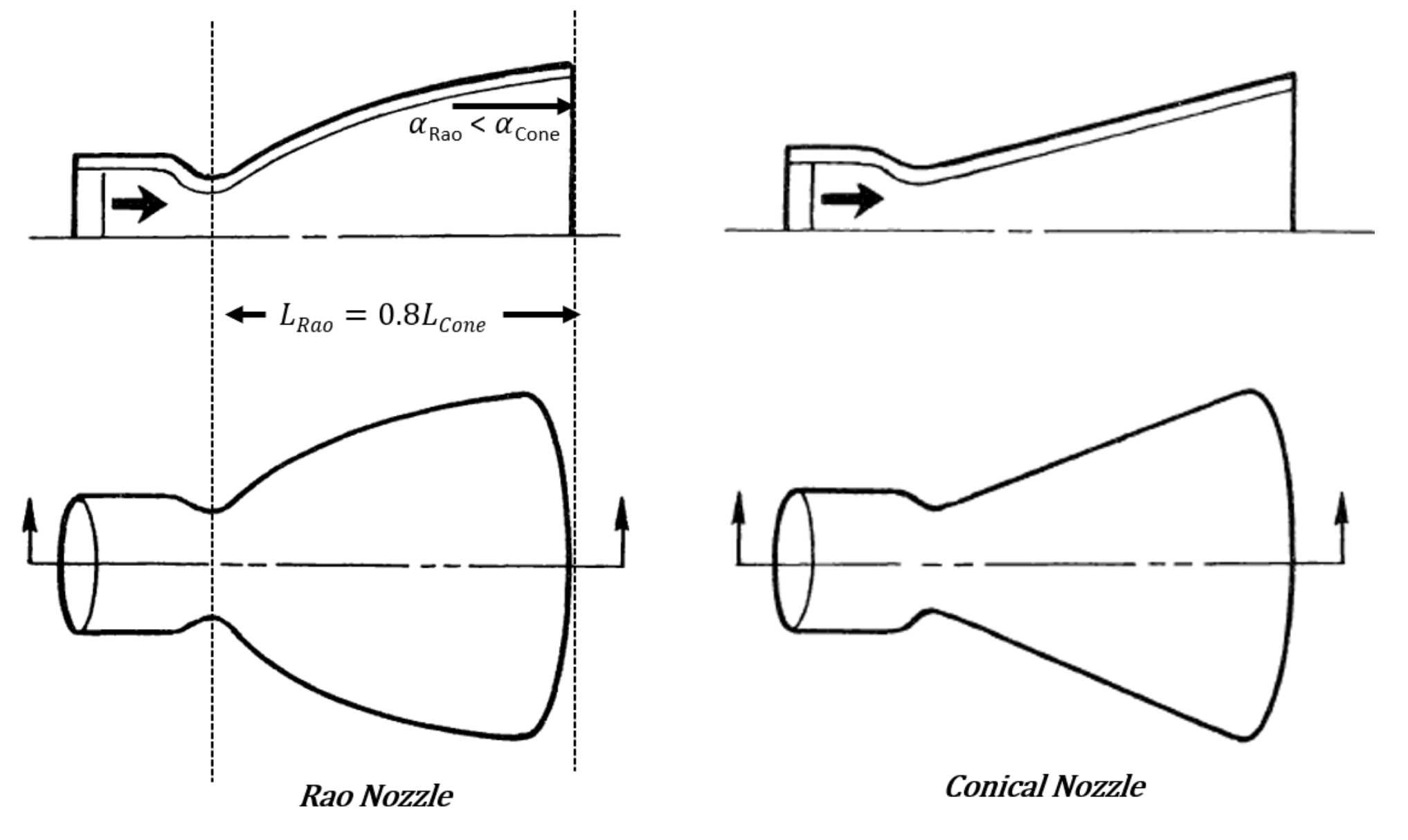
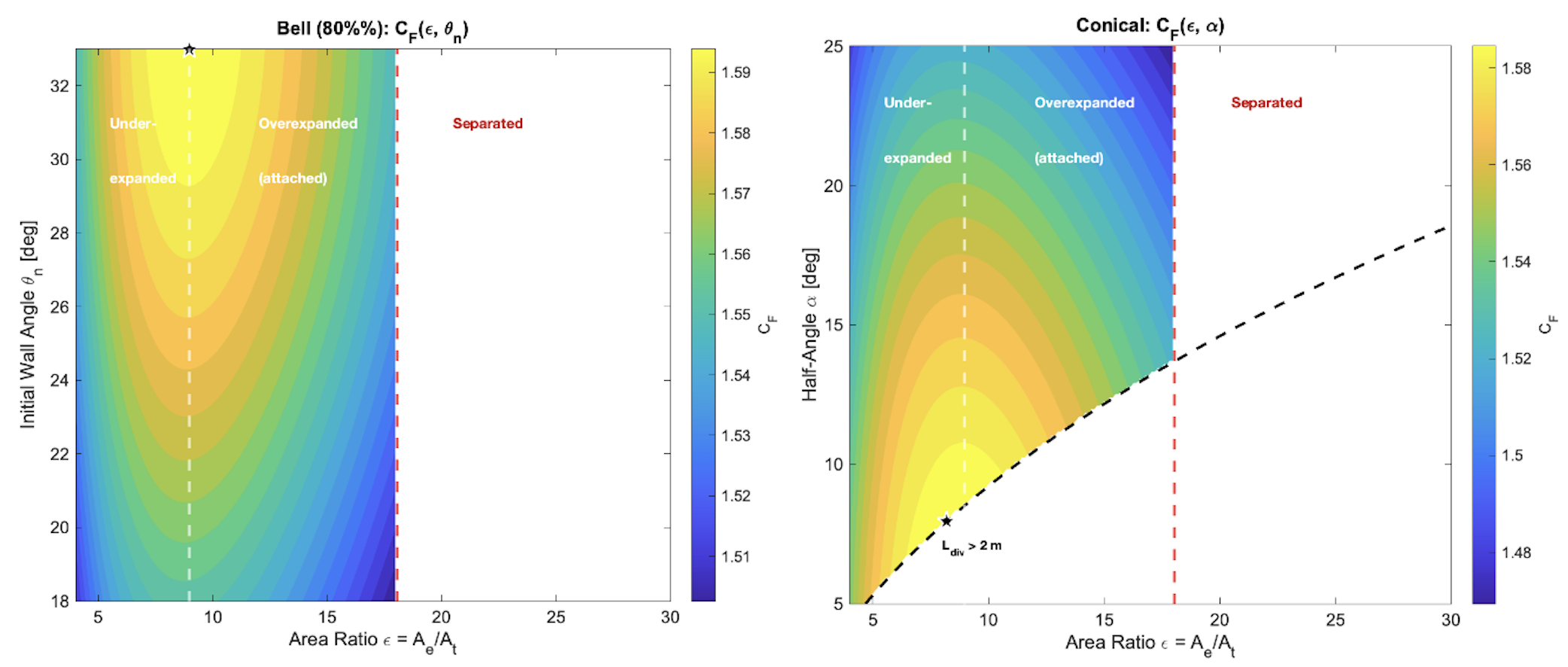
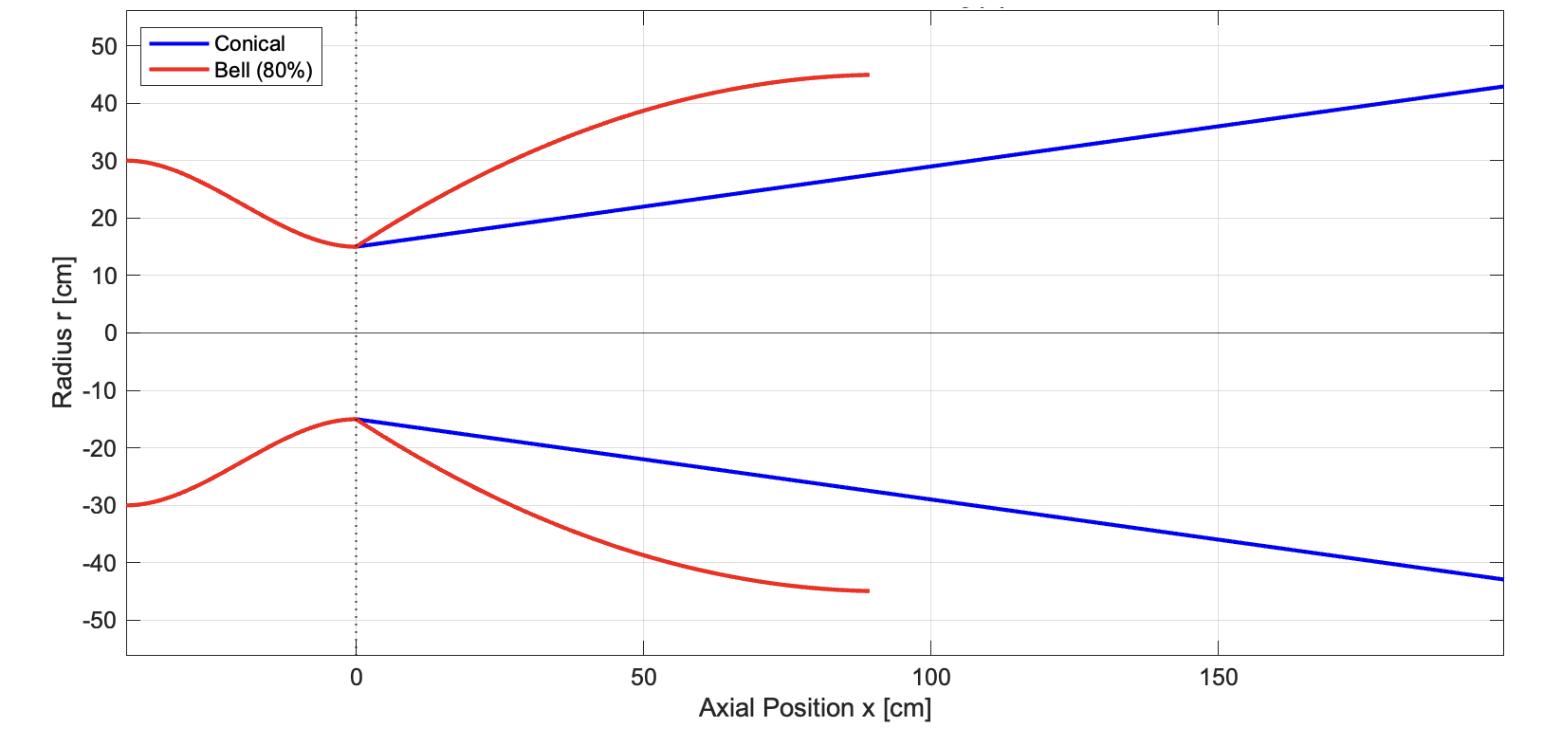
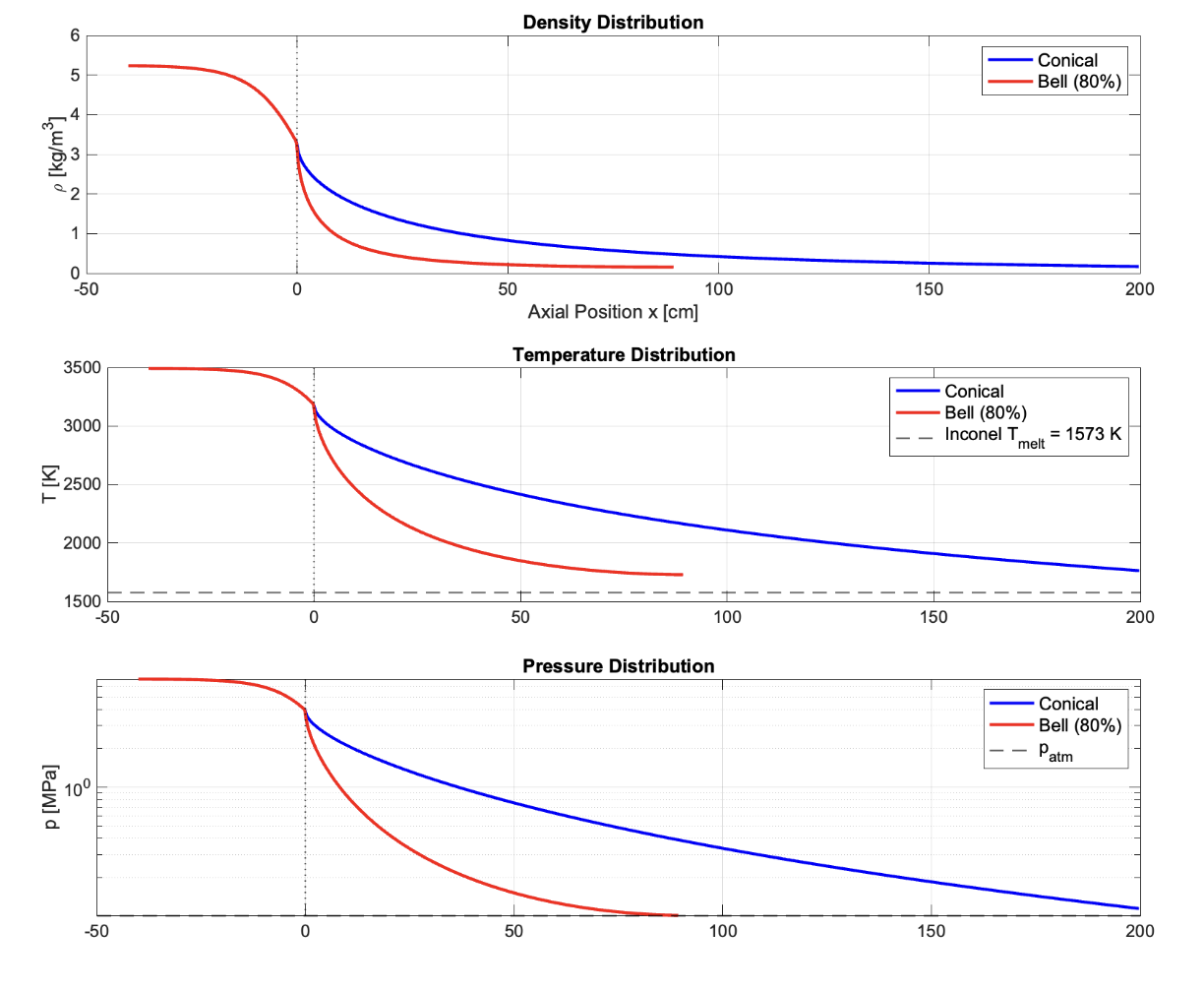
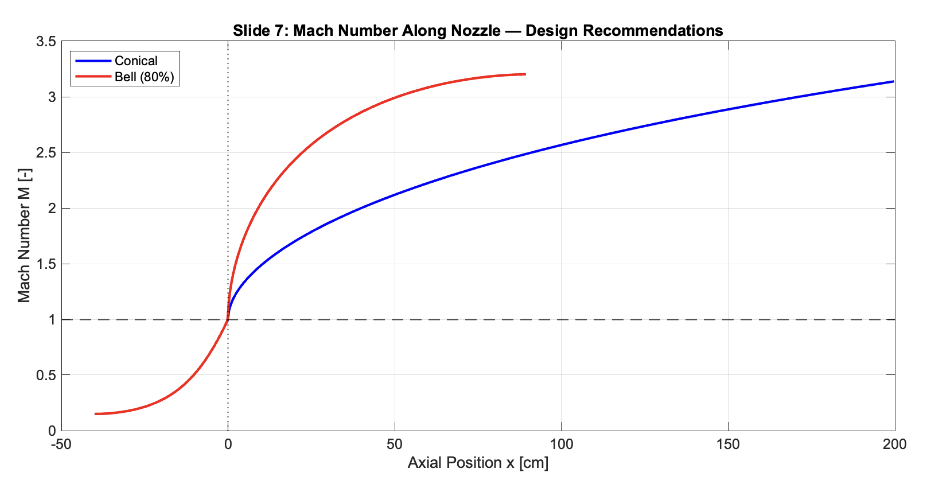
[image 1] The analysis compared two conventional de laval nozzle architectures: an 80%-length bell (Rao) nozzle and a standard conical nozzle.[image 2] The objective was to determine what nozzle geometry –– particularly expansion ratio (area ratio) and wall angle –– would create the most thrust while satisfying geometrical and flow constraints.[image 3] The resulting optimal bell and conical nozzle shapes are graphed above. Solely the diverging section of the nozzle was optimized (x > 0 m).[image 4] Exhaust density, temperature, and pressure all drop as the nozzle expands the gases. It should be noted that operating temperatures far exceed Inconel 718's melting point (~1600K); we proposed regenerative cooling to be implemented.[image 5] Mach number with respect to axial position of nozzle. At x < 0 m (combustion chamber), gases are subsonic. At the throat, M = 1, and at x > 0 m, the flow is accelerated to supersonic speeds by the nozzle.[image 6] Final result: the 80% bell shaped nozzle achieved higher C_F and Isp at less than half the diverging length (image [3]) of the equivalent conical design.